What is a cell?
A calm introduction to the body’s smallest living building block: what a cell is made of, how it knows what to do, and why understanding it helps you understand leukemia.

01Short answer
02Simple explanation
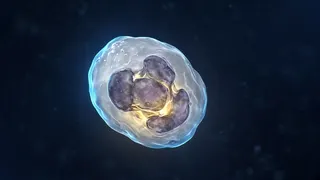
Imagine a cell as a small but very well-run city. The city has a wall with gates — the cell membrane — which decides what comes in and what goes out. On the wall are “doorbells” called receptors: neighbouring cells and hormones ring them to send the cell messages.
At the centre of the city is a large archive and library — the nucleus. It holds every instruction for building and running the city, written in a long molecule called DNA. Books never leave this library: instead, a copy of the page that is needed is made and sent out to the workshops.
The city’s power stations (mitochondria) turn food into energy, its workshops (ribosomes) assemble proteins by following the instructions, and its recycling centres (lysosomes) take apart worn-out parts and clear away waste. Almost all of the work in a cell is done by proteins.
Nearly every cell in the body carries the same DNA, but each cell reads only the “chapters” it needs. That is why a nerve cell sends signals, a muscle cell contracts and a red blood cell carries oxygen. This process of specialising is called differentiation (maturation).
Cells have a life cycle too: they are born, do their job, divide when needed and, when their time comes, quietly die to make room for new ones. Blood cells are renewed especially quickly. In leukemia, a young blood cell in the bone marrow gets an error in its instructions: it keeps dividing, does not mature and does not die on time. Knowing how a cell normally works makes it much easier to see what that error means.
03Scientific explanation
The cell is the basic structural and functional unit of living things. Human cells are eukaryotic: their DNA is kept in a nucleus surrounded by a membrane. On the outside, the cell is enclosed by the plasma membrane, a double layer of lipids studded with transporter proteins, channels and receptors. Inside is the cytoplasm: the fluid cytosol, the cytoskeleton and the organelles.
The main organelles are the mitochondria, which convert energy from food into a form the cell can use (ATP) and carry a small DNA of their own; the ribosomes, which build proteins; the endoplasmic reticulum and Golgi apparatus, which process and “package” proteins and lipids; and the lysosomes, which break down worn-out components. The nucleus is wrapped in the nuclear envelope and acts as the command centre that tells the cell to grow, mature, divide or die.
Human DNA contains about 3 billion “letters” (base pairs) and is divided into 46 chromosomes. There are roughly 20,000 protein-coding genes. A gene’s information is first copied into RNA (transcription) and then translated into protein on a ribosome (translation). Which genes are read is decided by regulatory proteins and by chemical “tags” on the DNA (epigenetic regulation) — and differentiation depends on exactly this selective reading.
Cells “talk” to each other using signalling molecules. A growth factor binds to its receptor, a chain of proteins inside the cell (for example, kinases) switches each other on in turn, and certain genes are eventually activated in the nucleus. In blood formation, examples of such signals include erythropoietin (EPO), thrombopoietin and granulocyte colony-stimulating factor (G-CSF). Normal tissue keeps a precise balance between cell division, maturation and programmed cell death (apoptosis); cancer, including leukemia, is a disruption of that balance caused by genetic changes.
04What happens in the body?
Membrane and signals
Every cell “listens” to its surroundings. Receptors on the membrane recognise hormones, growth factors and signals from neighbouring cells. When a signal arrives, a kind of relay race starts inside the cell, and the message reaches the nucleus: “divide”, “wait”, “mature” or “end your life”. In some leukemias one link in this relay is stuck in the “on” position — for example, the BCR::ABL1 protein in chronic myeloid leukemia.
The nucleus — the instruction centre
The DNA in the nucleus is packaged into chromosomes. Before dividing, a cell copies all of its DNA precisely, so that each new cell receives a complete set of instructions. Copying errors happen, but the cell has proofreading and repair systems that find and fix them. Errors that are not repaired can become mutations.

Energy and production
Mitochondria supply the cell with energy, and ribosomes produce proteins. Proteins work as enzymes, transporters, antibodies, signalling molecules and parts of the cell’s framework. For example, hemoglobin in red blood cells is a protein that carries oxygen, and the antibodies made by B lymphocytes are proteins that recognise germs.
Blood cells are cells too
Blood cells are specialised cells made in the bone marrow. A mature red blood cell has no nucleus: it is a flexible little “bag” filled with hemoglobin. White blood cells do have a nucleus, and they fight infection. Platelets are not whole cells at all, but small fragments that break off a large marrow cell called a megakaryocyte.

05How does a cell “make decisions”?
A healthy cell’s behaviour is like a chain that starts with a signal and ends with a specific action. In leukemia, one of the links in this chain is broken.



06The main parts of a cell
| Part | What it does | Simple comparison | Link to leukemia |
|---|---|---|---|
| Cell membrane | Encloses the cell and controls what passes through | City wall and gates | CD markers on its surface help identify the type of leukemia |
| Receptors | Recognise signals from outside | Doorbell | Some targeted drugs act on receptors or on the signalling chain |
| Cytoplasm | Jelly-like interior where the organelles sit | City streets | How a cell looks under the microscope (for example, its granules) helps diagnosis |
| Nucleus | Stores DNA and directs the cell’s work | Archive and library | The large nucleus of blasts is one of the features seen under the microscope |
| DNA and chromosomes | Hold all the instructions | Books and pages | Leukemia starts with acquired changes in DNA |
| Mitochondria | Produce energy from food | Power station | Some drugs act on the cell’s energy and survival pathways |
| Ribosomes | Build proteins | Workshop | Abnormal genes produce abnormal proteins |
* This table is a simplified overview. CD markers and targeted treatments are covered in more detail in separate topics.
07Key terms
- Cell
- The smallest structural and functional unit of a living organism.
- Membrane
- The thin covering around a cell that controls what goes in and out.
- Cytoplasm
- The jelly-like fluid and organelles inside the membrane but outside the nucleus.
- Organelle
- A tiny “organ” inside a cell that does a particular job (for example, a mitochondrion).
- Nucleus
- The centre where DNA is stored and the cell’s work is directed.
- DNA
- The long molecule that carries all of a cell’s instructions.
- Protein
- A molecule built from a gene’s instructions that does most of the work in a cell.
- Receptor
- A protein on or inside a cell that recognises a signalling molecule and responds to it.
- Differentiation
- The maturing of a cell into a specialised form that does a particular job.
- Apoptosis
- Controlled, “planned” cell death; the body’s way of removing damaged and old cells.
08Key points
- A cell is the smallest living unit of the body; the human body is made of trillions of cells.
- The membrane protects the cell and receives signals; the nucleus stores the instructions (DNA).
- Genes are instructions for making proteins, and proteins do most of the work in a cell.
- Cells with the same DNA specialise in different jobs by reading different genes.
- A healthy cell divides only when needed, matures, and dies on time.
- Blood cells are made in the bone marrow and are renewed very quickly.
- Leukemia begins when the balance between division, maturation and death is lost in a blood-forming cell.
- Knowing these basics makes your doctor’s explanations and your test results easier to follow.
09Frequently asked questions
How many cells are in the body?
The exact number varies from person to person, but reputable sources describe the human body as being made of trillions of cells. A very large share of them are blood cells, especially red blood cells.
Do all cells have the same DNA?
Almost: most cells in the body carry the same set of DNA. The difference is that each type of cell switches different genes on or off. There are exceptions — for example, mature red blood cells have no nucleus and therefore no nuclear DNA. Leukemia cells carry additional DNA changes acquired later in life.
Why do cells have to die? Isn’t that bad?
No — programmed cell death (apoptosis) is essential for health. It clears away old, unneeded or DNA-damaged cells and keeps tissues in balance. One of the problems with leukemia cells is precisely that they do not die when they should.
How is a leukemia cell different from a normal cell?
A leukemia cell comes from a normal blood cell, but its DNA has changed. Because of these changes it no longer follows signals: it divides too much, often fails to mature and lives longer than normal. Doctors detect these differences using the microscope, flow cytometry and genetic tests.
Why do I need to know about cells?
During treatment you will often hear words like “blast”, “CD marker”, “mutation” and “cell cycle”. Understanding how a cell works makes these words easier to follow, helps you ask your doctor more precise questions and can make things feel less frightening. Only your care team can explain what applies to your own situation.
Can foods or supplements “strengthen” cells and cure leukemia?
A balanced diet matters for your overall health, but no food, herb or supplement “repairs” leukemia cells or replaces treatment. Some supplements can interact with medicines, so discuss any supplement with your doctor first.
10Questions for your doctor
Take these questions to your appointment. The ones you save are collected on the “My questions” page and stay on this device only.
How are leukemia cells different from healthy cells?
How will treatment affect my healthy cells?
Which cells in my body recover fastest after treatment?
Can you recommend a reliable source that explains what is happening at the cell level?
12Sources
- MedlinePlus Genetics (U.S. National Library of Medicine). What is a cell?
- MedlinePlus Genetics (U.S. National Library of Medicine). What are proteins and what do they do?
- MedlinePlus Genetics (U.S. National Library of Medicine). How do cells divide?
- National Human Genome Research Institute (NHGRI). Talking Glossary of Genomic and Genetic Terms: Cell
- National Human Genome Research Institute (NHGRI). Talking Glossary: Nucleus
- National Human Genome Research Institute (NHGRI). Talking Glossary: Mitochondria
- National Human Genome Research Institute (NHGRI). Talking Glossary: Cell Membrane (Plasma Membrane)
- National Human Genome Research Institute (NHGRI). Talking Glossary: Ribosome
- National Cancer Institute (NCI). What Is Cancer?
- National Cancer Institute (NCI). NCI Dictionary of Cancer Terms: cell
- American Society of Hematology (ASH). Blood Basics