DNA, genes and proteins
Inside every cell is a library of instructions for building and running the body. This topic explains how that library — DNA — is “read”, how genes become proteins, and why this matters for understanding and treating leukemia.

01Short answer
02Simple explanation
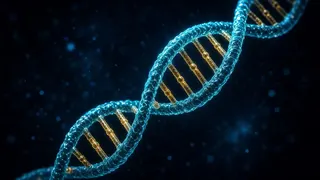
Think of DNA as a huge recipe book kept in the nucleus of every cell. The book is written with just four letters: A, T, G and C. The order of these letters — like the order of letters in words — carries the meaning.
The individual recipes in the book are genes. Each gene describes how to make one “dish” — one protein. Humans have about 20,000 such recipes. Although almost every cell in the body holds the same book, each cell opens only the recipes it needs: a red cell precursor “reads” the hemoglobin recipe, and a lymphocyte reads the recipe for antibodies.
The cell does not take the book out of the nucleus — instead it makes a copy of the recipe it needs. This copy is called mRNA. The copy leaves the nucleus for the cell’s “kitchen” — the ribosomes — where the protein is assembled from amino acids, one by one, like beads on a string.
Proteins are the cell’s workers. Some pass on the signal to “divide” or “stop”, some give the command to “mature and specialise”, some repair mistakes in the DNA, and some tell a worn-out cell that “your time has come”.
In leukemia, some recipes in the book change: a letter is misspelled, a piece goes missing, or parts of two recipes get stuck together. The resulting protein either works far too hard or does not work at all. The good news: scientists know many of these faulty proteins and have developed targeted drugs that switch them off.
03Scientific explanation
DNA (deoxyribonucleic acid) is a spiral molecule made of two strands. Each strand is built from nucleotides — a sugar, a phosphate and one of four bases (adenine, thymine, guanine, cytosine). The bases pair up: A always with T, and G with C. Human DNA consists of about 3 billion bases, and more than 99% of them are the same in all people. Most DNA is stored in the nucleus, with a small amount in the mitochondria.
A gene is the functional unit of DNA. Genes range in size from a few hundred to more than 2 million base pairs. The Human Genome Project estimated 20,000–25,000 protein-coding genes; later studies point to a figure near the lower end. Besides coding regions, the genome contains sequences that regulate when and where genes are switched on and off.
The path from gene to protein has two steps, together called gene expression. In transcription, in the nucleus, the gene’s DNA sequence is copied into mRNA. In translation, in the cytoplasm, a ribosome reads the mRNA three bases at a time (codons) and adds the matching amino acid for each codon; proteins are built from 20 kinds of amino acid. The finished protein folds into a three-dimensional shape, and its shape determines its function. Which genes are read, and how much, is controlled by transcription factors and epigenetic marks (DNA methylation, histone modifications), which switch genes on and off without changing the DNA sequence.
Leukemia-related genes mostly fall into a few functional groups: signalling kinases (e.g. ABL1, FLT3), transcription factors that steer cell maturation (RUNX1, CEBPA), epigenetic regulators (DNMT3A, TET2, IDH1/IDH2), genes that change where proteins sit and how they work inside the cell (NPM1), and guardians of the genome (TP53). When these proteins change, a cell may divide without control, stop maturing or escape death. That is why genetic tests are part of modern diagnosis, and why targeted drugs exist for some of these changes: for example, tyrosine kinase inhibitors against the BCR::ABL1 kinase, and FLT3 and IDH1/IDH2 inhibitors.
04What happens in the body?
From gene to protein: two steps
First, in the nucleus, a copy of the gene — mRNA — is made (transcription). Then the copy travels to the ribosomes, where the protein is assembled from amino acids (translation). This happens every second in the trillions of cells in your body.

Every cell reads the same book differently
A liver cell and a lymphocyte have the same DNA, yet they do completely different jobs. The reason is that each cell switches different genes on and off. As blood cells mature, the set of active genes changes step by step; in leukemia, this programme is disrupted.
Proteins are the cell’s switches
Some proteins are an “accelerator” that pushes the cell to divide; others are a “brake”. In leukemia, the accelerator can get stuck down (for example, a permanently active kinase) and the brake can fail. Both lead to uncontrolled growth.

How did this knowledge change treatment?
Once a faulty protein is identified, it can be targeted. The best-known example is CML: drugs that block the BCR::ABL1 protein have turned the disease, for most people, into a condition kept under control for many years. Today there are targeted drugs for other leukemias too, and new ones are being studied.
05From instruction to cell behaviour
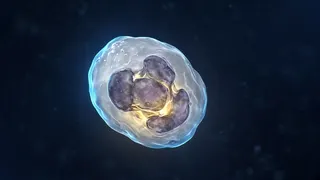
An instruction in DNA becomes cell behaviour in four steps. In leukemia, an error can arise at any link in this chain.


06Key ideas and how they relate to leukemia
| Idea | Simple comparison | Link to leukemia (example) |
|---|---|---|
| DNA | Instruction book | Changes build up in the DNA of a leukemia cell |
| Base (A, T, G, C) | Letter | Changing a single letter can change how a protein works |
| Gene | Recipe | Changes in genes such as FLT3, NPM1 and TP53 affect outlook and treatment |
| mRNA | Copy of the recipe | Some tests (e.g. PCR for BCR::ABL1) measure mRNA |
| Protein | Worker | A faulty protein (e.g. the BCR::ABL1 kinase) becomes the target of a targeted drug |
| Kinase | Signal switch | A kinase stuck “on” drives the cell to divide non-stop |
| Transcription factor | The “editor” choosing which recipe to read | When disrupted, the cell stops maturing |
| Epigenetics | Bookmarks and notes in the book | DNMT3A, TET2, IDH changes; hypomethylating drugs act at this level |
* The examples are simplified. Only your hematologist, using your genetic test results, can explain which changes your leukemia has and what they mean.
07Key terms
- DNA
- Deoxyribonucleic acid; the molecule that carries inherited instructions.
- Base
- A “letter” of DNA: A, T, G or C.
- Gene
- A stretch of DNA with instructions for a particular protein.
- Genome
- All of an organism’s DNA.
- mRNA
- A copy of a gene that carries its instructions from the nucleus to a ribosome.
- Transcription
- Making an mRNA copy from DNA.
- Translation
- Building a protein from mRNA.
- Protein
- A molecule made of amino acids that does work in the cell.
- Kinase
- An enzyme that passes on signals by adding phosphate groups to other proteins.
- Epigenetics
- Marks that switch genes on and off without changing the DNA sequence.
08Key points
- DNA is an instruction book of four bases (A, T, G, C); humans have about 3 billion bases.
- A gene is a recipe for one protein; humans have about 20,000 protein-coding genes.
- A gene is first copied into mRNA, then turned into a protein on a ribosome.
- Proteins control cell division, maturation and death.
- All cells have the same DNA, but each cell switches on different genes.
- In leukemia, some genes change and their proteins work incorrectly.
- Targeted drugs block specific faulty proteins.
09Frequently asked questions
Will the DNA changes in my leukemia pass to my children?
In most cases, no. The vast majority of genetic changes in leukemia arise during life, only in blood-forming cells (somatic changes), and do not reach egg or sperm cells. Rarely, there are inherited changes that increase the tendency to develop leukemia; we discuss these in “Risk factors”.
Why is genetic testing needed?
Genetic testing helps identify the exact leukemia subtype, the risk group and, in some cases, whether a targeted drug is likely to work. The results can directly shape the treatment plan. Some results take from a few days to a few weeks to come back.
How is a targeted drug different from chemotherapy?
Classic chemotherapy affects all rapidly dividing cells. A targeted drug is aimed at a specific faulty protein or signalling pathway in the leukemia cell. Targeted drugs have side effects too, and are sometimes used together with chemotherapy. See “Targeted therapy” for more.
Can I “fix” my DNA with diet or lifestyle?
A healthy lifestyle matters for general health, but the genetic changes in leukemia cells cannot be corrected with food, supplements or vitamins. Some supplements can even interfere with treatment. Discuss any supplement with your hematologist first.
My report mentions “FLT3-ITD” or “NPM1”. What are these?
These are gene names and the kinds of change found in them. What each means depends on the type of leukemia and the other findings. Go through your results with your doctor; we also cover biomarkers in a separate topic.
If there are changes in my DNA, is it my fault?
No. Most genetic changes in leukemia happen by chance when cells divide and have nothing to do with anything a person did or did not do. It is no one’s fault.
10Questions for your doctor
Take these questions to your appointment. The ones you save are collected on the “My questions” page and stay on this device only.
Which gene changes were found in my leukemia cells?
How do these changes affect my treatment?
When do we expect the genetic results?
Can I have a written copy of the results?
12Sources
- MedlinePlus Genetics (U.S. National Library of Medicine). What is DNA?
- MedlinePlus Genetics (U.S. National Library of Medicine). What is a gene?
- MedlinePlus Genetics (U.S. National Library of Medicine). How do genes direct the production of proteins?
- MedlinePlus Genetics (U.S. National Library of Medicine). What are proteins and what do they do?
- MedlinePlus Genetics (U.S. National Library of Medicine). Can genes be turned on and off in cells?
- National Human Genome Research Institute (NHGRI). Genetic Code — Talking Glossary
- National Human Genome Research Institute (NHGRI). Messenger RNA (mRNA) — Talking Glossary
- National Human Genome Research Institute (NHGRI). Epigenomics Fact Sheet
- National Cancer Institute (NCI). The Genetics of Cancer
- National Cancer Institute (NCI). Targeted Therapy to Treat Cancer
- American Cancer Society. Genes and Cancer
- National Cancer Institute (NCI). Adult Acute Myeloid Leukemia Treatment (PDQ®) — Patient Version