Tzatziki
A cold dip of strained yoghurt, raw cucumber, garlic and dill.
With care: in a safer version
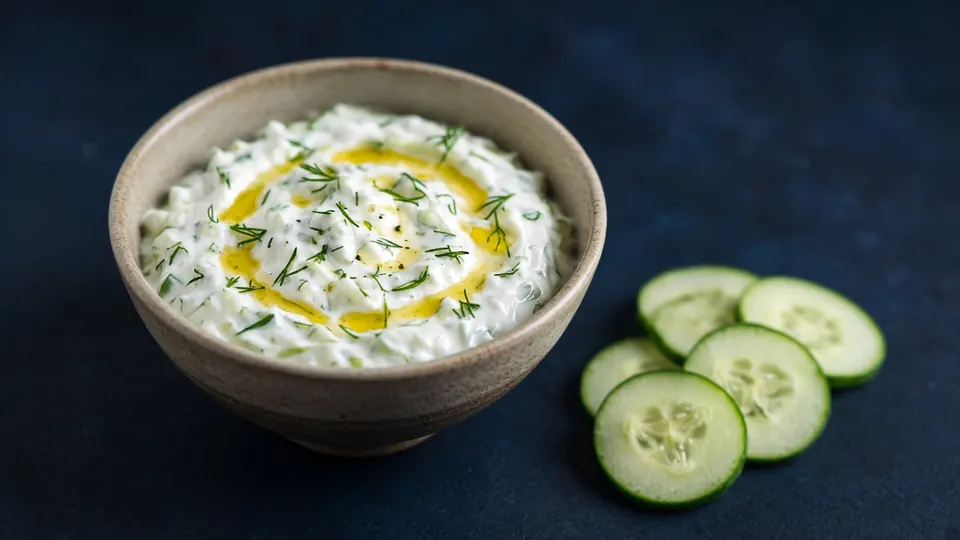
Ingredients
- strained yoghurt
- cucumber
- garlic
- dill
- olive oil
- salt
How it is prepared
Grated cucumber is squeezed and mixed with yoghurt, garlic and dill.
Food safety with low immunity
- Use only pasteurised milk, yoghurt, cream and cheese.
- Wash raw vegetables and herbs well under running water. During neutropenia some teams advise avoiding raw salads and herbs — ask about your own rules.
How to prepare it during treatment
Make it fresh at home with pasteurised yoghurt and keep it chilled. For raw cucumber and herbs during low counts, follow your team’s rules.
Your diet during treatment is agreed with your doctor. Sample 7-day menu for the treatment period →
Storage
Make it fresh, keep it chilled and eat it the same day. Do not leave it out on the table.
Reheating
Eaten cold — not reheated. That is why freshness and the fridge matter.
Symptoms it may suit
- Taste changes. Aromatic spices, herbs or a little sourness can help when food tastes bland or metallic (if there are no mouth sores).
These are general observations: what suits you can change from day to day.
Treatment phases
- Before treatmentmay suit
- During a coursemay suit
- Low counts (neutropenia)Only in the safer version and if your team agreesmay suit
- Between coursesmay suit
- After treatmentmay suit
Phase notes are general. During low counts, follow only your care team’s food rules.
If you have other conditions
- Stomach and gut. Contains dairy. With lactose intolerance or bowel problems, discuss suitability with your team.
- Osteoporosis. Dairy is a source of calcium. With osteoporosis, discuss nutrition for bone health with your team.
- High blood pressure, Heart disease, Kidney disease. Often salty (stock, salty cheese, sausage, pickles). With high blood pressure, heart or kidney disease, discuss salt limits with your team.
Nutrition (per 100 g)
| Energy | 91 kcal |
|---|---|
| Protein | 5.2 g |
| Fat | 6 g |
| Carbohydrate | 4.1 g |
| Fibre | 0.2 g |
| Sodium | 307 mg |
Figures are for a comparable item in the USDA FoodData Central database: “Tzatziki dip”. Home recipes vary — treat this as a rough guide, not an exact calculation. USDA FoodData Central, FDC ID 2705448
More from this cuisine
Related topics
Food safetyNeutropenic diet (low-microbial diet)PasteurisedCore cooking temperatureLeftoversCross-contamination
Sources
- Centers for Disease Control and Prevention (CDC). Safer Food Choices for People With Weakened Immune Systems
- FoodSafety.gov (U.S. HHS). Cook to a Safe Minimum Internal Temperature
- USDA Food Safety and Inspection Service. Leftovers and Food Safety
- U.S. Food and Drug Administration (FDA). Food Safety for Older Adults and People with Cancer, Diabetes, HIV/AIDS, Organ Transplants, and Autoimmune Diseases
- Food Standards Agency (UK). Chilling
- World Health Organization (WHO). Five keys to safer food manual
- Memorial Sloan Kettering Cancer Center. Food Safety During Cancer Treatment
- National Cancer Institute (NCI). Eating Hints: Before, during, and after Cancer Treatment
- BMJ Supportive & Palliative Care, 2019. Neutropenic diets to prevent cancer infections: updated systematic review and meta-analysis
- U.S. Department of Agriculture (USDA). FoodData Central — Food and Nutrient Database for Dietary Studies (FNDDS)