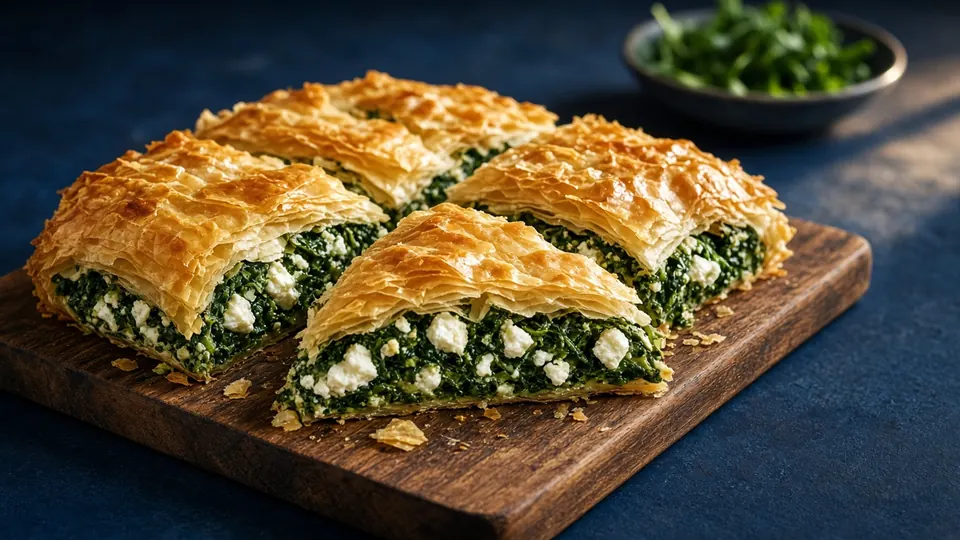
Spanakopita (spinach and feta pie)
A crisp filo pie filled with spinach, feta and herbs.
Well-cooked hot dish
Ingredients
- filo pastry
- spinach
- feta
- eggs
- spring onion
- dill
- olive oil
How it is prepared
Spinach is wilted, mixed with feta and egg, layered between filo sheets and baked until golden.
Food safety with low immunity
- Soft, mould-ripened and market cheeses may be unpasteurised. Choose packaged cheese labelled pasteurised, or use cheese melted in a hot dish.
- Eggs should be fully cooked, with firm whites and yolks.
How to prepare it during treatment
Choose feta made from pasteurised milk and serve the pie hot.
Your diet during treatment is agreed with your doctor. Sample 7-day menu for the treatment period →
Storage
Once cooled, refrigerate (within 2 hours) and eat within 1–2 days.
Reheating
In the oven until hot in the centre; in a microwave, turn halfway.
Symptoms it may suit
- Low appetite. Gives a lot of energy and protein in a small portion — can help when appetite is low.
- Weight loss. Energy-dense and easy to enrich (oil, cheese, yoghurt) — can help with weight loss.
These are general observations: what suits you can change from day to day.
Treatment phases
- Before treatmentmay suit
- During a coursemay suit
- Low counts (neutropenia)Freshly cooked and hotmay suit
- Between coursesmay suit
- After treatmentmay suit
Phase notes are general. During low counts, follow only your care team’s food rules.
If you have other conditions
- Heart disease. Lots of green herbs or leaves (vitamin K). If you take blood-thinning medicine, discuss keeping the amount steady with your team.
- High blood pressure, Heart disease, Kidney disease. Often salty (stock, salty cheese, sausage, pickles). With high blood pressure, heart or kidney disease, discuss salt limits with your team.
- Heart disease, Obesity, Liver disease, Stomach and gut. Can be fatty. With heart, liver or digestive disease, or excess weight, discuss fat content and portions with your team.
- Autoimmune disease, Stomach and gut. Contains wheat (gluten). With coeliac disease and some autoimmune conditions, discuss it with your team.
- Stomach and gut. Contains dairy. With lactose intolerance or bowel problems, discuss suitability with your team.
Nutrition (per 100 g)
| Energy | 212 kcal |
|---|---|
| Protein | 8.3 g |
| Fat | 15.2 g |
| Carbohydrate | 10.3 g |
| Fibre | 1 g |
| Sodium | 392 mg |
Figures are for a comparable item in the USDA FoodData Central database: “Spanakopita”. Home recipes vary — treat this as a rough guide, not an exact calculation. USDA FoodData Central, FDC ID 2708729
More from this cuisine
Related topics
Food safetyNeutropenic diet (low-microbial diet)PasteurisedCore cooking temperatureLeftoversCross-contamination
Sources
- Centers for Disease Control and Prevention (CDC). Safer Food Choices for People With Weakened Immune Systems
- FoodSafety.gov (U.S. HHS). Cook to a Safe Minimum Internal Temperature
- USDA Food Safety and Inspection Service. Leftovers and Food Safety
- U.S. Food and Drug Administration (FDA). Food Safety for Older Adults and People with Cancer, Diabetes, HIV/AIDS, Organ Transplants, and Autoimmune Diseases
- Food Standards Agency (UK). Chilling
- World Health Organization (WHO). Five keys to safer food manual
- Memorial Sloan Kettering Cancer Center. Food Safety During Cancer Treatment
- National Cancer Institute (NCI). Eating Hints: Before, during, and after Cancer Treatment
- BMJ Supportive & Palliative Care, 2019. Neutropenic diets to prevent cancer infections: updated systematic review and meta-analysis
- U.S. Department of Agriculture (USDA). FoodData Central — Food and Nutrient Database for Dietary Studies (FNDDS)