Bone marrow monitoring
Leukaemia starts in the bone marrow, so the most accurate check of remission is often done in the marrow too. But how often does the marrow need testing in remission, and when is a blood test enough? This topic explains the role of bone marrow tests during follow-up.

01Short answer
02Simple explanation
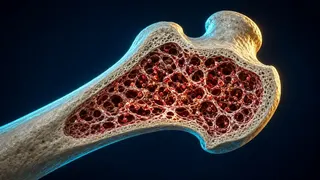
The bone marrow is the “factory” for blood cells — and leukaemia starts there.
A blood test shows what the factory produces; a marrow test shows what is happening inside it.
In remission, the marrow is tested at set times or when a blood test changes.
One sample goes to several laboratories: microscope, flow cytometry, chromosomes, genes.
In some leukaemias, such as CML, a blood test is often enough for follow-up.
03Scientific explanation
MRD schedule: according to the 2021 ELN MRD consensus, in NPM1-mutated and CBF AML, MRD can be checked regularly for about 2 years after treatment — in the marrow about every 3 months, or more often in the blood.
Confirming remission: according to ELN 2022, complete remission requires fewer than 5% blasts in the bone marrow; only a marrow test can show this.
CML: according to the ELN 2020 recommendations, response is monitored mainly with quantitative BCR::ABL1 PCR in the blood; a marrow test is needed at diagnosis and if response is lost or the disease progresses.
The procedure: according to MedlinePlus, aspiration and biopsy are usually taken from the back of the hip bone under local anaesthetic; mild soreness may last a few days.
04What happens in the body?
When is the marrow tested in remission?
There are three main situations. First, at the end of treatment, to confirm the response and its depth. Second, at set times according to the MRD plan. Third, when there are unexplained changes in a blood test, blasts in the blood or symptoms suggesting relapse. Some protocols also check the marrow regularly after a transplant.

One sample — several tests
Slides are made from the aspirate for the microscope and the percentage of blasts is counted. Flow cytometry looks for the “labels” of leukaemia cells and can measure MRD. Cytogenetics and FISH look at chromosomes; PCR and NGS look at genes. A biopsy shows how densely the marrow is filled with cells.

When is blood enough?
Some markers can also be followed in the blood. In CML, the BCR::ABL1 test is done on blood. In AML, some molecular markers can also be measured in blood, but a marrow sample is usually more sensitive. So doctors sometimes alternate blood and marrow tests.
How the procedure goes
You usually lie on your side or front. The skin and bone surface are numbed, then a special needle is used to take a little liquid marrow and, if needed, a small piece of bone. You may feel a brief pulling pain at the moment of aspiration. The whole procedure usually takes 15–30 minutes, and you can go home the same day.
Results and waiting
Microscopy can be ready within a few days, flow cytometry within a few days and genetic tests within one to three weeks. Waiting is stressful — ask when and from whom you will hear the result. Results are assessed together with blood tests and earlier marrow tests.
05Bone marrow monitoring in four steps
According to plan, or when needed.




06Why the marrow is tested in remission (simplified)
| Reason | What is checked | Note |
|---|---|---|
| End of treatment | Blasts, MRD | Confirming remission |
| MRD plan | Flow cytometry or PCR | Regularly in some AML and ALL |
| After a transplant | Blasts, MRD, share of donor cells | According to protocol |
| Changes in the blood | Looking for the cause | Relapse or another cause |
| Loss of response in CML | Chromosomes, mutations | A blood test is usually enough |
* The protocol and your haematologist decide which test is done and when.
07Key terms
- Aspiration
- Taking liquid bone marrow with a needle.
- Biopsy
- Taking a small piece of bone containing marrow.
- Myelogram
- Counting marrow cells under the microscope.
- Cellularity
- How densely the marrow is filled with cells.
- Flow cytometry
- A test that recognises cells by their surface “labels”.
- Cytogenetics
- The study of chromosomes.
- Chimerism
- The ratio of donor to own cells after a transplant.
- MRD
- Measuring small numbers of leukaemia cells that cannot be seen.
08Key points
- A marrow test is the most accurate check of remission.
- It is not done at every visit — by plan or when needed.
- One sample goes to several tests.
- In some AML, MRD is checked regularly.
- In CML, follow-up relies mainly on blood.
- The procedure is done under local anaesthetic.
- Do not hesitate to ask about pain relief.
- Results are interpreted together with blood tests.
09Frequently asked questions
How often is a marrow test needed in remission?
It depends on the type of leukaemia and the protocol. Sometimes only at the end of treatment, sometimes regularly in the first years.
Can a blood test replace a marrow test?
In some cases yes, for example in CML. In acute leukaemia, the marrow is often more sensitive.
Is the procedure very painful?
After the local anaesthetic, most people mainly feel pressure, with a brief pain during aspiration. Ask about sedation or pain relief.
When will the result be ready?
Microscopy and cytometry in a few days, genetic tests in one to three weeks.
What should I do afterwards?
Usually keep the dressing dry for 24 hours and avoid heavy lifting. Call if there is bleeding or a fever.
The report says the sample was “inadequate”. What does that mean?
It is not a mistake: sometimes marrow is hard to obtain. Your doctor may suggest repeating the test or using a blood test.
10Questions for your doctor
Take these questions to your appointment. The ones you save are collected on the “My questions” page and stay on this device only.
How often is a marrow test needed in remission?
Can a blood test replace a marrow test?
Is the procedure very painful?
When will the result be ready?
What should I do afterwards?
The report says the sample was “inadequate”. What does that mean?
12Sources
- MedlinePlus (U.S. National Library of Medicine). Bone Marrow Tests
- MedlinePlus (U.S. National Library of Medicine). Bone marrow aspiration
- MedlinePlus (U.S. National Library of Medicine). Bone marrow biopsy
- National Cancer Institute (NCI). NCI Dictionary of Cancer Terms: bone marrow aspiration
- National Cancer Institute (NCI). NCI Dictionary of Cancer Terms: minimal residual disease
- American Cancer Society. Tests for Acute Myeloid Leukemia (AML)
- American Cancer Society. Living as an Acute Myeloid Leukemia (AML) Survivor
- American Cancer Society. Living as an Acute Lymphocytic Leukemia Survivor
- Macmillan Cancer Support. Bone marrow biopsy
- Blood, 2021. Heuser M et al. 2021 Update on MRD in acute myeloid leukemia: a consensus document from the European LeukemiaNet MRD Working Party
- Blood, 2022. Döhner H et al. Diagnosis and management of AML in adults: 2022 recommendations from an international expert panel on behalf of the ELN
- Leukemia, 2020. Hochhaus A et al. European LeukemiaNet 2020 recommendations for treating chronic myeloid leukemia