Molecular remission
If leukaemia cells cannot be seen under the microscope, that is remission. But in some leukaemias it is possible to look even deeper — by searching for the disease’s genetic “trace”. This topic explains what molecular remission is, how it is measured and what the results mean.

01Short answer
02Simple explanation
A leukaemia can carry a genetic “fingerprint” — for example, two genes joined together. This trace can be looked for in blood or bone marrow.
PCR copies and measures tiny amounts of this trace many times over — it is thousands of times more sensitive than a microscope.
Molecular remission — the trace cannot be found, or its level is very low.
It is a deeper response than ordinary remission, but not the same as cure.
In leukaemias without such a trace, the depth of response is measured in other ways, for example by flow cytometry.
03Scientific explanation
CML: the BCR::ABL1 level is expressed on the International Scale (IS). According to ELN 2020, 0.1% or below is a major molecular response (MMR), while a 4-log reduction (MR4) or a 4.5-log reduction (MR4.5) counts as a deep molecular response.
Treatment-free remission: according to the ELN 2020 recommendations, after several years of therapy and roughly at least 2 years of deep molecular response, stopping the drug under close monitoring can be discussed for some patients.
AML: the 2021 ELN MRD consensus recommends tracking MRD by quantitative PCR in NPM1-mutated and CBF leukaemias (RUNX1::RUNX1T1, CBFB::MYH11); MRD-negative complete remission is recognised as a separate category.
ACS: the goal of AML treatment is complete remission and, where possible, “complete molecular remission”, in which leukaemia cannot be found even with sensitive molecular tests.
04What happens in the body?
What is a genetic trace?
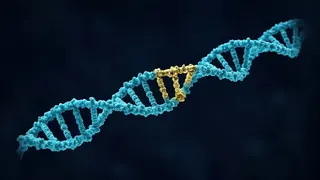
In some leukaemias the cells carry a particular genetic change: two genes joined together (for example, BCR::ABL1 or PML::RARA) or a mutation in a single gene (for example, NPM1). Healthy cells do not have this change. That is why it can be used as a trace of the leukaemia.
How PCR works
The laboratory extracts genetic material from blood or bone marrow. PCR then copies the tiny amount of marker many times, and the machine measures how many copies were made. The result is reported as a ratio of the marker to a normal gene — as a percentage or as a log reduction. Such a test can find one leukaemia cell among 10,000 to 100,000 cells.

Steps of response in CML
In CML, the BCR::ABL1 level is measured regularly, at first usually every 3 months. Important milestones are a fall to 1%, then to 0.1% (major molecular response) and to 10 times lower again and beyond (deep molecular response). Each step is 10 times lower than the one before — this is called a “log reduction”.

In acute leukaemias
In APL, the absence of PML::RARA after consolidation is considered molecular remission. In NPM1-mutated or CBF AML, the marker is measured regularly after courses and during follow-up. A renewed rise in the marker can sometimes be seen weeks or months before a clinical relapse — giving the doctor a chance to act earlier.
How to understand the result
A single result is not a verdict. Differences between laboratories, sample quality and test sensitivity all play a part. Doctors look at the direction of the line: steady and low is good; if it rises, the test is usually repeated. Keeping your own table of results is helpful.
05Molecular monitoring in four steps
The marker is identified, measured and followed over time.




06Examples of molecular markers (simplified)
| Leukaemia | Marker | What molecular remission means |
|---|---|---|
| CML | BCR::ABL1 | 0.1% or below — major response; a further 10-fold fall or more — deep response |
| APL | PML::RARA | The marker is not found after consolidation |
| NPM1-mutated AML | NPM1 | The marker is not found, or is very low and stable |
| CBF AML | RUNX1::RUNX1T1, CBFB::MYH11 | The marker is very low and not rising |
| Ph-positive ALL | BCR::ABL1 | The marker is not found |
| Leukaemias without a marker | — | Depth is measured by flow cytometry or NGS |
* Thresholds depend on the laboratory, the sensitivity of the test and the stage of treatment. Interpret your results only with your haematologist.
07Key terms
- Molecular remission
- The genetic trace of leukaemia is not found or is very low.
- PCR
- A laboratory method that copies and measures a small piece of DNA or RNA.
- Fusion gene
- An abnormal gene formed when two different genes join together.
- BCR::ABL1
- The fusion gene found in CML and some ALL.
- International Scale (IS)
- A common scale for comparing BCR::ABL1 results in CML.
- Major molecular response
- BCR::ABL1 at 0.1% or below in CML.
- Log reduction
- A fall in level by a factor of 10 each time.
- MRD
- Measurable residual disease — small numbers of leukaemia cells that cannot be seen.
08Key points
- Molecular remission is a deeper response than ordinary remission.
- It is measured using the genetic trace of the leukaemia.
- The main method is quantitative PCR.
- Not every leukaemia has a marker that can be tracked.
- In CML, results are reported on the International Scale.
- Look at the trend, not a single result.
- Where possible, use the same laboratory.
- Molecular remission is not the same as cure.
09Frequently asked questions
Is molecular remission the same as cure?
No. It is a very good response, but even the most sensitive test cannot see every cell. Follow-up continues.
Does my leukaemia have a molecular marker?
That depends on the genetic tests done at diagnosis. Ask your doctor: “Which marker can be tracked in my disease?”
My result went up a little. Is this a relapse?
Not necessarily. Small fluctuations are common. The test is usually repeated and the trend is assessed.
How often is the test done?
In CML, usually every 3 months at first, and less often once the response is stable. In acute leukaemias, the schedule is tied to the treatment plan.
If the report says “not detected”, does that mean zero?
It means the marker is below the test’s detection limit. That is why the report also states the sensitivity.
Can I stop my medicine in CML?
Some people can, after a long-lasting deep molecular response — only on their doctor’s decision and with close monitoring.
10Questions for your doctor
Take these questions to your appointment. The ones you save are collected on the “My questions” page and stay on this device only.
Is molecular remission the same as cure?
Does my leukaemia have a molecular marker?
My result went up a little. Is this a relapse?
How often is the test done?
If the report says “not detected”, does that mean zero?
Can I stop my medicine in CML?
12Sources
- National Cancer Institute (NCI). NCI Dictionary of Cancer Terms: polymerase chain reaction
- National Cancer Institute (NCI). NCI Dictionary of Cancer Terms: minimal residual disease
- MedlinePlus (U.S. National Library of Medicine). BCR-ABL1 Genetic Test
- MedlinePlus Genetics. NPM1 gene
- National Cancer Institute (NCI). Chronic Myeloid Leukemia Treatment (PDQ®) — Patient Version
- National Cancer Institute (NCI). Acute Myeloid Leukemia Treatment (PDQ®) — Patient Version
- American Cancer Society. Treatment Response Rates for Acute Myeloid Leukemia (AML)
- American Cancer Society. Treating Chronic Myeloid Leukemia
- NHS. Treatment for chronic myeloid leukaemia
- National Comprehensive Cancer Network (NCCN). NCCN Guidelines for Patients: Chronic Myeloid Leukemia
- Leukemia, 2020. Hochhaus A et al. European LeukemiaNet 2020 recommendations for treating chronic myeloid leukemia
- Blood, 2021. Heuser M et al. 2021 Update on MRD in acute myeloid leukemia: a consensus document from the European LeukemiaNet MRD Working Party
- Blood, 2022. Döhner H et al. Diagnosis and management of AML in adults: 2022 recommendations from an international expert panel on behalf of the ELN