CML: symptoms, phases and diagnosis
Chronic myeloid leukemia often develops slowly, and in many people it is found by chance on a routine blood test, without any symptoms. This topic covers the signs of CML, emergency situations, the phases of the disease, the tests used for diagnosis and roughly what the results mean.

01Short answer
02Simple explanation
In CML, two chromosomes in one stem cell — number 9 and number 22 — swap pieces. The shortened chromosome 22 is called the Philadelphia chromosome. This change creates a new gene, BCR::ABL1, which makes a protein that keeps telling the cell to “divide”. As a result, the marrow produces far too many white blood cells.
Unlike the acute leukemias, in the first stage of CML most of these cells still mature and work. That is why the disease can stay quiet for a long time. Many people learn they have CML after a blood test done for another reason shows a high white cell count.
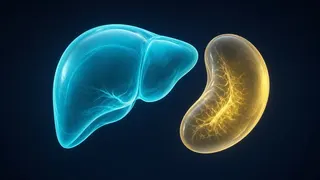
When symptoms do appear, they usually build up gradually: tiredness, weakness, loss of appetite and weight loss, night sweats and sometimes fever. As the spleen grows, there may be a heavy feeling under the left ribs, feeling full after small meals, and sometimes pain spreading to the left shoulder. Bone pain, easy bruising or pallor can also occur.
CML has three phases. Chronic phase is the earliest and calmest stage; the great majority of people are diagnosed in it. In accelerated phase the disease becomes more active. Blast phase resembles an acute leukemia. With modern targeted treatment, progression beyond chronic phase has become much rarer than it used to be.
The key diagnostic question is: do the cells carry BCR::ABL1? This is checked with genetic tests on blood. A bone marrow examination is done to confirm the phase and look for additional chromosome changes. The results guide the choice of treatment and future monitoring.
03Scientific explanation
The typical blood count shows leukocytosis — often marked — with granulocytes at every stage of maturation (myelocytes, metamyelocytes, neutrophils; a “left shift”), basophilia and often eosinophilia; platelets are often normal or high, and there may be mild anemia. Blasts on the smear are usually few. On examination, the spleen size (how many centimetres it extends below the rib margin) is recorded, because it is part of the risk calculation. LDH and uric acid may be raised.
Genetic confirmation: FISH shows the BCR::ABL1 fusion; quantitative RT-PCR (qPCR) both confirms the diagnosis and identifies the transcript type (usually e13a2 or e14a2 — the p210 protein; less often e1a2 or other atypical types). Knowing the transcript type matters because the BCR::ABL1 level is tracked on the International Scale (IS) with exactly this test throughout treatment. ELN 2020 requires a bone marrow aspirate at diagnosis: the blast and basophil percentages are needed to distinguish the phases, and the karyotype shows any additional chromosomal abnormalities (ACAs) in Philadelphia-positive cells.
The phases are defined slightly differently in different systems. ELN 2020: accelerated phase — 15–29% blasts in blood or marrow, basophils ≥20%, persistent thrombocytopenia unrelated to treatment, high-risk ACAs and others; blast phase — ≥30% blasts or extramedullary blast infiltration. ICC 2022 keeps the accelerated phase (10–19% blasts) and defines blast phase at ≥20% blasts. WHO 2022 has dropped accelerated phase as a separate phase, emphasising high-risk features in chronic phase instead; blast phase is defined by ≥20% blasts, extramedullary blast proliferation or increased lymphoblasts in blood or marrow. Blast phase can be myeloid or lymphoid, which flow cytometry shows.
Risk assessment: ELN 2020 recommends the ELTS score at diagnosis, based on age, spleen size, platelet count and blood blast percentage (the Sokal score is also still widely used). Before treatment, heart, liver and kidney function, lipids and glucose, an ECG, hepatitis B screening (risk of reactivation on tyrosine kinase inhibitors) and, where relevant, a pregnancy test are checked. Once treatment starts, ELN 2020 gives milestones for BCR::ABL1 (IS): ≤10% at 3 months, ≤1% at 6 months and ≤0.1% at 12 months (major molecular response, MMR). These milestones are interpreted with your doctor in light of your individual situation.
04What happens in the body?
Symptoms that need urgent help
Contact your doctor straight away or call emergency services if: you suddenly get severe pain under the left ribs or in the left shoulder (loss of blood supply to part of the spleen or, rarely, injury to it); bleeding will not stop, or many bruises and petechiae appear; you have a temperature of 38 °C or higher or shivering; you have breathlessness, a severe headache, vision changes or confusion (with a very high white cell count this can be leukostasis); in men, a painful erection that will not go away — also rare but an emergency. A sudden increase in bone pain, fever and sweating can signal that the disease is speeding up — tell your team quickly.
In what order are the tests done?
Usually: a blood count done by chance or because of symptoms → blood smear and examination (spleen size) → FISH and/or quantitative RT-PCR for BCR::ABL1 (from blood) → bone marrow aspirate (blast and basophil percentages, karyotype), often with a biopsy → phase and ELTS risk score → pre-treatment tests (ECG, blood chemistry, hepatitis B). For many people the diagnosis is fully clear within one or two weeks.

What do the results roughly mean?
Finding BCR::ABL1 confirms CML. If blasts are few and there are no signs of acceleration, this is chronic phase — the most common situation, with the best outlook. The ELTS score indicates low, intermediate or high risk and may influence the choice of drug. The transcript type is the “key” to your future monitoring tests.
Phases: why do they matter?
The phase sets the goal and intensity of treatment. In chronic phase, a daily tyrosine kinase inhibitor tablet is usually prescribed, and people can often keep working and living their normal lives. In accelerated and blast phase, treatment is more intensive and a stem cell transplant may be discussed.

Questions you can ask your doctor
Which phase is my CML in, and which criteria were used? What is my BCR::ABL1 transcript type? Are there additional chromosome changes on the karyotype? What is my ELTS (or Sokal) risk score? Which drug suits me and why? How often will BCR::ABL1 be checked and what are the goals? Do my other medicines or foods affect treatment? What should I do if I am planning a pregnancy?
The start of a long road
A CML diagnosis often means long-term treatment and monitoring. That can feel heavy at first, but for many people CML has become a chronic, controlled condition with modern drugs. Regular tests, taking the medicine on time and open communication with your team are the main supports along the way.
05CML: from blood count to phase
A CML diagnosis usually takes shape in four steps.




06Phases of CML (simplified, based on ELN 2020)
| Phase | Typical findings | What does it usually mean? |
|---|---|---|
| Chronic phase | Blasts <15%; no signs of acceleration; often no or mild symptoms | The most common phase; very good control with tyrosine kinase inhibitors |
| Accelerated phase | Blasts 15–29% or basophils ≥20%, persistent thrombocytopenia, high-risk additional chromosome changes | The disease is more active; treatment is stepped up and a transplant may be discussed |
| Blast phase | Blasts ≥30% (≥20% under WHO and ICC) or extramedullary blast deposits | Resembles acute leukemia; intensive treatment and often a transplant |
* Phase criteria differ slightly between ELN 2020, ICC 2022 and WHO 2022 (WHO 2022 has dropped accelerated phase as a separate phase). Discuss your own results with your hematologist.
07Key terms
- Philadelphia chromosome
- The shortened chromosome 22 created by the t(9;22) exchange between chromosomes 9 and 22.
- BCR::ABL1
- The fusion gene that drives CML; it makes a permanently active tyrosine kinase.
- Quantitative RT-PCR
- A sensitive test measuring the BCR::ABL1 level; the main method for tracking response.
- IS
- International Scale — lets BCR::ABL1 results from different labs be compared.
- Basophilia
- A raised number of basophils in the blood; typical of CML.
- ACA
- Additional chromosomal abnormalities in Philadelphia-positive cells.
- ELTS score
- A risk score based on age, spleen size, platelets and blast percentage.
- Tyrosine kinase inhibitor
- A targeted tablet that blocks the BCR::ABL1 protein.
- MMR
- Major molecular response — BCR::ABL1 ≤0.1% (IS).
- Splenomegaly
- An enlarged spleen.
08Key points
- CML often causes no symptoms and is found on a routine blood test.
- Signs: tiredness, weight loss, night sweats, a heavy feeling under the left ribs.
- Sudden severe abdominal pain, bleeding, high fever or breathlessness are emergencies.
- The diagnosis is confirmed with a BCR::ABL1 (Philadelphia chromosome) test.
- The bone marrow shows the phase and any additional chromosome changes.
- There are three phases: chronic, accelerated and blast; most people are diagnosed in chronic phase.
- The ELTS score estimates risk; BCR::ABL1 (IS) tracks the response to treatment.
- Write down your questions and go through the results with your hematologist.
09Frequently asked questions
I have no complaints at all. Do I really need treatment?
Yes, usually. Even without symptoms, untreated CML can move into more serious phases over time. Targeted drugs greatly reduce this risk, and many people keep their normal way of life.
Is a bone marrow test essential, or is a blood test enough?
BCR::ABL1 can be detected in blood, but to define the phase accurately and see additional chromosome changes, international recommendations advise a bone marrow aspirate at diagnosis. Later monitoring is done mainly with blood tests.
Why does the transcript type matter?
It shows which variant of the BCR::ABL1 gene you have. The monitoring test must be set up for that variant. Atypical types sometimes need special lab methods.
Can CML turn into acute leukemia?
That is what blast phase means. With modern treatment, especially when the response is good, it is rare. Regular BCR::ABL1 monitoring helps spot a weakening response early and change treatment in time.
Is CML inherited, or can my family get it from me?
No. The Philadelphia chromosome is acquired during life; it is not passed down from parents or on to children. CML is not contagious either.
What should I do if I am planning a pregnancy?
Discuss it with your hematologist as early as possible. Some tyrosine kinase inhibitors can be harmful in pregnancy. With a planned approach, many people with CML have healthy babies.
10Questions for your doctor
Take these questions to your appointment. The ones you save are collected on the “My questions” page and stay on this device only.
Which phase is my CML in, and how was this determined?
Is my BCR::ABL1 result reported on the international scale?
Which result will show that treatment is working well?
How would we know if the phase changes?
12Sources
- American Cancer Society. Signs and Symptoms of Chronic Myeloid Leukemia
- American Cancer Society. Tests for Chronic Myeloid Leukemia
- American Cancer Society. Phases of Chronic Myeloid Leukemia
- National Cancer Institute (NCI). Chronic Myeloid Leukemia Treatment (PDQ®) — Patient Version
- National Cancer Institute (NCI). Chronic Myeloid Leukemia Treatment (PDQ®) — Health Professional Version
- Blood Cancer United (formerly The Leukemia & Lymphoma Society). Chronic myeloid leukemia (CML) signs and symptoms
- Blood Cancer United (formerly The Leukemia & Lymphoma Society). Diagnosing CML
- National Comprehensive Cancer Network (NCCN). NCCN Guidelines for Patients: Chronic Myeloid Leukemia
- NHS. Chronic myeloid leukaemia — Symptoms
- NHS. Chronic myeloid leukaemia — Tests and next steps
- Leukemia (Nature), 2020. European LeukemiaNet 2020 recommendations for treating chronic myeloid leukemia
- Annals of Oncology (ESMO), 2017. Chronic myeloid leukaemia: ESMO Clinical Practice Guidelines for diagnosis, treatment and follow-up
- American Journal of Hematology, 2024. Chronic myeloid leukemia: 2025 update on diagnosis, therapy, and monitoring
- Leukemia (Nature) — WHO 5th edition. WHO Classification of Haematolymphoid Tumours: Myeloid and Histiocytic/Dendritic Neoplasms
- Blood (American Society of Hematology), 2022. International Consensus Classification of Myeloid Neoplasms and Acute Leukemias