Is it inherited?
Parents and children often ask whether this will pass down through the family. In most cases it will not.

01Short answer
02Simple explanation
Gene changes come in two kinds: inborn (in every cell) and acquired (in one cell line only).
Leukemia usually involves the second kind.
Such a change does not reach eggs or sperm, so it is not passed to children.
03Scientific explanation
Changes found in leukemia cells, such as BCR::ABL1, FLT3 and NPM1, are somatic and not inherited.
Germline predisposition, for example changes in RUNX1, CEBPA or DDX41, is uncommon; the WHO classification lists it separately. If several blood disorders run in a family, the doctor may offer germline testing.
04What happens in the body?
Two kinds of genetic change
An inborn change comes from a parent and is present in every cell. An acquired change arises in one cell during life. Most leukemias develop the second way.
When family risk is considered
If several close relatives had leukemia or MDS, if the diagnosis came at a young age, or if a related donor is being considered for transplant, the doctor may check for an inherited predisposition. This also matters for choosing the right donor.

What it means for children
A parent’s leukemia usually does not mean a leukemia risk for the children. A healthy lifestyle and ordinary check-ups are enough; special tests are needed only if a doctor recommends them.

05Where the change comes from
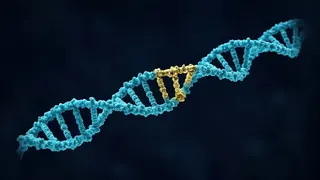
The path of a genetic change in leukemia.



06Key points at a glance
| Topic | In brief |
|---|---|
| Two kinds of genetic change | An inborn change comes from a parent and is present in every cell. An acquired change arises in one cell during life. Most leukemias develop the second way. |
 When family risk is considered | If several close relatives had leukemia or MDS, if the diagnosis came at a young age, or if a related donor is being considered for transplant, the doctor may check for an inherited predisposition. This also matters for choosing the right donor. |
 What it means for children | A parent’s leukemia usually does not mean a leukemia risk for the children. A healthy lifestyle and ordinary check-ups are enough; special tests are needed only if a doctor recommends them. |
07Key terms
- Inherited
- Passed from parent to child.
- Germline change
- A genetic change present in every cell from birth.
- Genetic counselling
- A meeting with a specialist who explains family risk.
08Key points
- Most leukemias are not inherited.
- The changes arise during life.
- Rare family syndromes exist.
- If in doubt, ask for genetic counselling.
09Frequently asked questions
Should my child be tested?
Usually not. If there are several cases in the family, discuss it with the doctor.
Can a brother or sister be a donor?
Yes, siblings are often the best match; if a predisposition is suspected, the donor is checked further.
Is the Philadelphia chromosome in CML inherited?
No, it is an acquired change found only in the leukemia cells.
10Questions for your doctor
Take these questions to your appointment. The ones you save are collected on the “My questions” page and stay on this device only.
Should my child be tested?
Can a brother or sister be a donor?
Is the Philadelphia chromosome in CML inherited?
12Sources
- National Cancer Institute (NCI). The Genetics of Cancer
- National Cancer Institute (NCI). Leukemia—Patient Version
- MedlinePlus (U.S. National Library of Medicine). Leukemia
- NHS. Acute myeloid leukaemia
- National Cancer Institute (NCI). Common Cancer Myths and Misconceptions
- NHS (UK). Chronic lymphocytic leukaemia
- NHS (UK). Chronic myeloid leukaemia
- National Cancer Institute (NCI). What Is Cancer?
- American Cancer Society. Risk Factors for Acute Myeloid Leukemia (AML)
- Cancer.Net (ASCO). Talking With Family and Friends