Hairy cell leukemia (HCL)
HCL is a rare, slow-growing leukemia named after how the leukemia cells look under the microscope — they have fine, hair-like projections on their surface. The good news is that HCL responds very well to treatment, and many people live normal lives for many years.

01Short answer
02Simple explanation
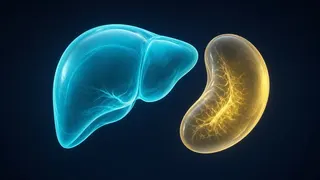
In HCL, the problem is in B lymphocytes. Under the microscope the abnormal B cells have fine, hair-like projections around their edges — which is where the name comes from. These cells multiply slowly and gather mainly in the bone marrow and spleen.
The cells gathering in the marrow, and the fibrous tissue they cause, get in the way of normal blood formation. As a result, red cells, platelets and white cells fall, causing tiredness, breathlessness, frequent infections, easy bruising and bleeding. A very low monocyte count is typical of HCL.
An enlarged spleen can cause pain or fullness under the left ribs, and sometimes you feel full after eating only a little. Swollen lymph nodes are less common in HCL.
Scientists have found the same change in the BRAF gene — the V600E mutation — in almost every case of classic HCL. This discovery has made diagnosis easier and opened the way to targeted drugs.
For people with no symptoms and reasonably good blood counts, doctors may simply monitor for a while. When treatment is needed, a short course of chemotherapy often gives a long remission. If the disease comes back, treatment can be repeated or replaced with a different drug.
03Scientific explanation
HCL is an indolent, low-grade B-cell lymphoid malignancy; there are only 1,200–1,300 new cases a year in the US (NCI), about 2% of all leukemias. Typical findings are splenomegaly, leukopenia (occasionally leukocytosis), pancytopenia, monocytopenia and a “dry tap” — failure to obtain an aspirate because of marrow fibrosis. Diagnosis relies on the blood smear, a marrow biopsy and immunophenotyping: in addition to the B-cell antigens CD19, CD20 (very bright) and CD22, the cells express CD11c, CD25, CD103 and CD123.
BRAF V600E is the defining genetic feature of classic HCL: the mutation permanently activates the BRAF kinase and keeps the MEK–ERK signalling pathway switched on. The NCI describes HCL variant (HCL-v) as about 10% of cases, with a higher white count (15–50 × 10⁹/L), a different marker profile (CD25 absent, CD103 variable) and no BRAF mutation; this form responds less well to treatment. WHO 2022 has dropped HCL-v as a separate category and classifies these cases mainly as “splenic B-cell lymphoma/leukemia with prominent nucleoli”.
The decision to treat is based on signs of progression: cytopenias (especially if symptomatic), a growing spleen or infectious complications. People without symptoms and with non-critical cytopenias can be monitored closely. According to the NCI, the standard of care is cladribine (with or without rituximab); another purine analogue, pentostatin, is also effective. Because cladribine causes prolonged immunosuppression, chemotherapy-free options — BRAF inhibitors (vemurafenib, dabrafenib; combined with rituximab or trametinib) — may be preferred for older or frail people or those with active infections.
At relapse, options include re-treatment with a purine analogue (especially if the first remission was long), BRAF inhibitors, rituximab, ibrutinib, bendamustine-rituximab and, less often, splenectomy and interferon. HCL with unmutated IGHV (about 12%) has been linked to cladribine resistance and faster progression. In the NCI’s words, HCL is “highly treatable but rarely cured”; because it is easily controlled, many people have prolonged survival with treatments given in sequence.
04What happens in the body?
Spleen and marrow: the main “home”
HCL cells gather in the marrow and cause fibrous tissue (fibrosis), so sometimes no fluid can be drawn during a marrow aspirate — this is called a “dry tap”. In that case, a marrow biopsy is essential for diagnosis. The spleen is often enlarged and causes discomfort under the left ribs.

How is it diagnosed?
Hairy cells may be seen on a blood smear. Flow cytometry shows markers typical of HCL (CD11c, CD25, CD103, CD123). A BRAF V600E test confirms the diagnosis and helps tell HCL apart from similar diseases.
Targeted treatment: switching off the BRAF signal
BRAF inhibitors block the constant “grow” signal sent by the mutant BRAF protein. They are especially useful for people for whom a long period of weakened immunity after chemotherapy would be risky, and they are usually taken as tablets.

Treatment and protection from infection
A course of cladribine is usually short, but white cells can fall very low in the following weeks. If you develop a fever during this time, it is important to contact your doctor urgently. Your doctor will give you specific advice on preventing infections.
05HCL: from mutation to treatment
How HCL develops and is treated, in four steps.



06Classic HCL and HCL variant (HCL-v)
| Feature | Classic HCL | HCL-v (no longer a separate WHO 2022 category) |
|---|---|---|
| Frequency | Most cases | About 10% |
| White cell count | Usually low (leukopenia) | Often high (15–50 × 10⁹/L) |
| Monocytes | Very low | Usually not reduced |
| Markers | CD11c, CD25, CD103, CD123 positive | CD25 negative, CD103 variable |
| BRAF V600E | Almost always present | Absent |
| Response to cladribine | Very good | Poorer; other options are often needed |
* This table is a simplified comparison based on NCI PDQ information. The diagnosis is confirmed by a hematologist and a hematopathologist.
07Key terms
- HCL
- Hairy cell leukemia — a rare, slow-growing B-cell leukemia.
- Pancytopenia
- A fall in all types of blood cells.
- Monocytopenia
- A low monocyte count; typical of HCL.
- Splenomegaly
- An enlarged spleen.
- Marrow fibrosis
- An increase in fibrous tissue in the marrow.
- “Dry tap”
- Failure to draw fluid during a marrow aspirate.
- BRAF V600E
- The mutation in classic HCL that permanently activates the BRAF kinase.
- Cladribine
- A purine analogue used as standard treatment for HCL.
- BRAF inhibitor
- A targeted drug that blocks the signal of mutant BRAF.
- HCL-v
- HCL variant — a form without the BRAF mutation that behaves differently.
08Key points
- HCL is a rare, usually slow-growing B-cell leukemia.
- Its cells look “hairy” under the microscope.
- It gathers mainly in the marrow and spleen; pancytopenia and an enlarged spleen are typical.
- Almost all classic HCL carries the BRAF V600E mutation.
- People without symptoms may not need treatment straight away.
- Standard treatment is cladribine (with or without rituximab).
- BRAF inhibitors are a chemotherapy-free option.
- With treatments given in sequence, many people live for many years.
09Frequently asked questions
The name sounds frightening. Is it linked to hair loss?
No. The word “hairy” only describes how the leukemia cells look under the microscope — they have fine projections on their surface. It has nothing to do with the hair on your head.
Does treatment need to start right away?
Not always. If you have no symptoms and your blood counts are acceptable, your doctor may suggest monitoring. If blood counts worsen, the spleen grows or infections appear, treatment begins.
What is cladribine treatment like?
Cladribine is usually given as a short course — into a vein or under the skin. In the following weeks the risk of infection rises, so you should contact your team straight away if you get a fever. Your hematologist will explain the details of the protocol.
Can HCL come back?
Yes, sometimes years later. But relapse also responds well to treatment: the same drug can be given again, or you can switch to another option such as a BRAF inhibitor. Regular follow-up visits help catch a relapse early.
Can I live a normal life with HCL?
Many people stay in long remission after treatment and return to work and family life. Protecting yourself from infection needs special attention during treatment and for a while afterwards.
Which vaccines can I have?
The type and timing of vaccines depend on your treatment stage; live vaccines are usually avoided. Check with your hematologist which vaccines suit you.
10Questions for your doctor
Take these questions to your appointment. The ones you save are collected on the “My questions” page and stay on this device only.
Which tests confirmed the diagnosis of hairy cell leukemia?
Does treatment need to start now?
How much will my infection risk rise during treatment?
How often should I be checked after treatment?
12Sources
- National Cancer Institute (NCI). Hairy Cell Leukemia Treatment (PDQ®) — Patient Version
- National Cancer Institute (NCI). Hairy Cell Leukemia Treatment (PDQ®) — Health Professional Version
- Current Oncology Reports (PMC). Hairy Cell Leukemia: Where Are We in 2023?
- Leukemia (Nature) — WHO 5th edition. WHO Classification of Haematolymphoid Tumours: Lymphoid Neoplasms
- National Cancer Institute (NCI). NCI Dictionary of Cancer Terms: immunophenotyping
- National Cancer Institute (NCI). Targeted Therapy to Treat Cancer
- American Cancer Society. Oncogenes, Tumor Suppressor Genes, and DNA Repair Genes
- MedlinePlus (U.S. National Library of Medicine). Bone marrow diseases
- National Cancer Institute (NCI). NCI Dictionary of Cancer Terms: bone marrow
- National Cancer Institute (NCI). NCI Dictionary of Cancer Terms: white blood cell