Myeloid and lymphoid: two blood-cell families
All blood cells start from the same stem cell, but they soon split into two large families: myeloid and lymphoid. When one of these words appears in the name of a leukemia, it tells you which family it started in — and that matters a great deal for choosing treatment.

01Short answer
02Simple explanation
Picture blood cells as a large family. At its head is the stem cell. Two related lines branch off from it: myeloid and lymphoid. Each line has its own “professions”.
The myeloid family handles the body’s day-to-day supplies: red cells carry oxygen, platelets stop bleeding, and neutrophils and monocytes are the “rapid response team” that attacks germs first. This family grows up and matures mainly in the bone marrow.
The lymphoid family is the body’s “intelligence service and special forces”. B lymphocytes make antibodies, T lymphocytes recognise and destroy infected cells and direct the immune response, and NK cells rapidly attack suspicious cells. Lymphocytes are born in the bone marrow, but some mature in the thymus (a small gland behind the breastbone) and “stand guard” in the lymph nodes and spleen.
Leukemia begins in a cell of one of these families. Leukemias with “myeloid” in the name (AML, CML) arise from the myeloid line, while those with “lymphoblastic” or “lymphocytic” (ALL, CLL) arise from the lymphoid line. Lymphomas and myeloma also come from the lymphoid line.
Knowing which family a leukemia belongs to is important, because treatment differs a lot between the two groups. To find out, doctors look at special “name badges” on the cell surface — markers. Occasionally a leukemia cell carries the badges of both families; this is called mixed phenotype acute leukemia.
03Scientific explanation
In the hierarchy of blood formation, multipotent progenitors gradually split into two main directions: the common myeloid progenitor (CMP), which gives rise to the megakaryocyte-erythroid line (platelets and red cells) and the granulocyte-monocyte line (neutrophils, eosinophils, basophils, monocytes and some dendritic cells); and the common lymphoid progenitor (CLP), which gives rise to the B, T and NK lines. Modern research shows that this split is less a rigid “two branches” and more a gradual, flexible process, but the two-line model remains the basis of clinical classification.
Functionally, myeloid cells are mainly players in innate immunity — fast, non-specific defence — while lymphocytes form the basis of adaptive immunity, which targets specific germs and creates memory. B cells mature in the bone marrow and, after meeting an antigen, can become antibody-secreting plasma cells; T-cell precursors travel from the marrow to the thymus and mature there. NK cells are closer to innate immunity.
To determine the lineage of a leukemia cell, immunophenotyping (flow cytometry) measures CD markers on and inside the cell. Myeloperoxidase (MPO), CD13, CD33 and CD117 are used for the myeloid line; CD14, CD64 and CD11c for monocytic differentiation; CD19, CD22, CD79a and CD10 for the B line; cytoplasmic or surface CD3, CD7 and CD5 for the T line; and CD34 and TdT for immaturity. If a cell meets both myeloid and lymphoid criteria, it is mixed phenotype acute leukemia (MPAL) — a rare group of leukemias of “ambiguous lineage”.
The 5th edition of the WHO classification (2022) likewise divides hematolymphoid tumours into two large groups: myeloid neoplasms (AML, MDS, myeloproliferative neoplasms — including CML — and MDS/MPN, including CMML) and lymphoid neoplasms (B- and T-lymphoblastic leukemia/lymphoma, CLL/small lymphocytic lymphoma, hairy cell leukemia, lymphomas and plasma cell neoplasms such as myeloma). ALL and lymphoblastic lymphoma are considered two forms of the same disease: the difference lies mainly in whether it predominates in the bone marrow or in the lymph nodes/thymus.
04What happens in the body?
The myeloid family: supplies and first defence
Red cells, platelets, neutrophils, eosinophils, basophils and monocytes belong to the myeloid line. They carry oxygen, stop bleeding and respond first to germs. Diseases that can arise from this line include AML, APL, CML, MDS and CMML.

The lymphoid family: targeted immunity
B lymphocytes make antibodies, T lymphocytes direct the immune response and destroy infected cells, and NK cells attack suspicious cells. Lymphocytes also live in the lymph nodes, spleen and thymus. Diseases that can arise from this line include ALL, CLL, hairy cell leukemia, lymphomas and myeloma.

How is the lineage determined?
The main test is flow cytometry: cells are “tagged” with fluorescent antibodies, and the machine measures which markers each cell carries. Microscopy, cytogenetics and molecular tests complete the picture.
What does this split mean for treatment?
Myeloid and lymphoid leukemias respond to different drugs. For example, ALL treatment uses steroids and asparaginase, and immunotherapy directed at B-cell markers (CD19, CD22); AML is treated with other chemotherapy regimens and targeted drugs aimed at myeloid features.
05From one stem cell to two families
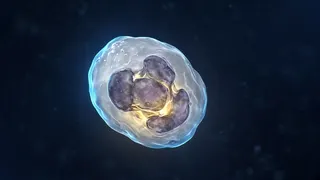
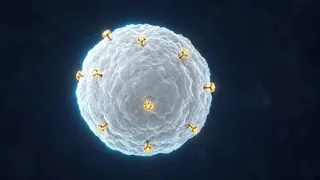
The path that begins with the stem cell splits in two directions. The name of a leukemia shows where along this path it began.


06Which disease comes from which family?
| Disease | Family (lineage) | In brief |
|---|---|---|
| Acute myeloid leukemia (AML) | Myeloid | Immature myeloid blasts multiply quickly |
| Acute promyelocytic leukemia (APL) | Myeloid | A special subtype of AML; PML::RARA |
| Chronic myeloid leukemia (CML) | Myeloid | BCR::ABL1; overproduction of mature myeloid cells |
| Myelodysplastic neoplasms (MDS) | Myeloid | Faulty blood production; sometimes progresses to AML |
| CMML, JMML | Myeloid | Rare diseases with raised monocyte counts |
| Acute lymphoblastic leukemia (ALL) | Lymphoid | B or T lymphoblasts; the most common leukemia in children |
| Chronic lymphocytic leukemia (CLL) | Lymphoid | Mature-looking B lymphocytes build up |
| Hairy cell leukemia (HCL) | Lymphoid | A rare B-cell leukemia; BRAF V600E |
| Lymphomas | Lymphoid | Lymphocyte cancers that start mainly in lymph nodes |
| Myeloma | Lymphoid | A cancer of plasma cells (fully mature B cells) |
| Mixed phenotype acute leukemia (MPAL) | Both | Rare; cells carry markers of both lines |
* MDS, lymphomas and myeloma are not leukemias, but they arise in the same blood-forming system; the differences are explained in a separate topic.
07Key terms
- Myeloid
- Relating to the line of red cells, platelets, granulocytes and monocytes.
- Lymphoid
- Relating to the line of B, T and NK cells.
- Granulocyte
- A white cell with granular cytoplasm: neutrophil, eosinophil, basophil.
- B lymphocyte
- A lymphocyte that makes antibodies.
- T lymphocyte
- A lymphocyte that directs the immune response and destroys infected cells.
- NK cell
- A “natural killer” lymphocyte that rapidly attacks suspicious cells.
- Thymus
- A gland behind the breastbone where T cells mature.
- Innate immunity
- Fast, non-specific first-line defence.
- Adaptive immunity
- Defence aimed at a specific germ that creates memory.
- Immunophenotyping
- Identifying a cell type by its markers.
08Key points
- All blood cells start from one stem cell and split into two families: myeloid and lymphoid.
- The myeloid family: red cells, platelets, neutrophils, eosinophils, basophils, monocytes.
- The lymphoid family: B, T and NK cells.
- Myeloid leukemias: AML, APL, CML, CMML, JMML.
- Lymphoid leukemias: ALL, CLL, hairy cell leukemia; lymphomas and myeloma also come from the lymphoid line.
- Lineage is determined from cell markers using flow cytometry.
- Lineage is one of the key pieces of information for choosing treatment.
09Frequently asked questions
What is the difference between “lymphoblastic” and “lymphocytic”?
A “lymphoblast” is an immature lymphoid cell; lymphoblasts build up in acute leukemia (ALL). “Lymphocytic” refers to mature-looking lymphocytes, which build up in chronic leukemia (CLL). Both belong to the lymphoid family, but they are different diseases.
Are ALL and lymphoma related?
Yes. Lymphoblastic leukemia and lymphoblastic lymphoma are two forms of the same disease: when it is mainly in the bone marrow it is called leukemia, and when it is mainly in the lymph nodes or thymus it is called lymphoma. Treatment approaches are often similar.
Can a myeloid leukemia turn into a lymphoid one?
Usually not — the lineage is determined at diagnosis and stays the same during treatment. Very rarely, a change of lineage at relapse (“lineage switch”) has been described, especially after some immunotherapies. In such cases doctors repeat the tests.
How is mixed phenotype leukemia treated?
It is a rare disease, and treatment is often individualised: sometimes ALL-type regimens, sometimes AML-type regimens, and sometimes a transplant is planned. In these cases, treatment at an experienced hematology centre is especially important.
Does the lineage determine the outlook?
Not on its own. Besides lineage, the outlook depends on the subtype, genetic changes, age, general health and response to treatment. For example, different leukemias of the same lineage can have very different results.
Where do I find my flow cytometry result, and how do I read it?
The result usually appears in the lab report as a list of CD markers. It is hard to interpret on your own, so ask your doctor to explain what it means. We cover flow cytometry in detail in the “Tests” section.
10Questions for your doctor
Take these questions to your appointment. The ones you save are collected on the “My questions” page and stay on this device only.
Is my leukemia myeloid or lymphoid?
How does this difference change my treatment?
Which test determined this precisely?
Is there any chance of a mixed type?
12Sources
- National Cancer Institute (NCI). NCI Dictionary of Cancer Terms: myeloid stem cell
- National Cancer Institute (NCI). NCI Dictionary of Cancer Terms: lymphoid stem cell
- National Cancer Institute (NCI). NCI Dictionary of Cancer Terms: thymus
- National Cancer Institute (NCI). NCI Dictionary of Cancer Terms: innate immunity
- National Cancer Institute (NCI). NCI Dictionary of Cancer Terms: adaptive immunity
- National Cancer Institute (NCI). NCI Dictionary of Cancer Terms: immunophenotyping
- American Cancer Society. What Is Acute Myeloid Leukemia (AML)?
- American Cancer Society. Typing of Acute Lymphocytic Leukemia (ALL)
- American Society of Hematology (ASH). Blood Basics
- American Society of Hematology (ASH). Lymphoma
- American Society of Hematology (ASH). Myeloma
- Leukemia (Nature) — WHO 5th edition. WHO Classification of Haematolymphoid Tumours: Lymphoid Neoplasms