Mutations: how DNA changes
A mutation is a change in the “text” of DNA. Most mutations are harmless or are repaired by the cell itself. This topic explains how mutations arise, why a few of them lead to leukemia, and whether they are inherited.

01Short answer
02Simple explanation
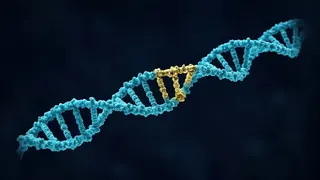
If DNA is a book of billions of letters, a mutation is a typo in that book. Every time a cell divides, the whole book is copied, and when copying such an enormous text, the occasional mistake is only natural.
The cell has excellent “proofreaders”: DNA repair proteins find and fix the vast majority of errors. Most of the typos that slip through are harmless too — they land where there are no genes, or do not affect how a protein works. With age, small harmless changes like these build up in everyone’s cells.
Problems arise when a typo spoils an important recipe — a gene that controls cell division, maturation or death. These are called “driver” mutations. One driver mutation is usually not enough; leukemia needs several such changes to build up in the same cell.
Mutations can come from two places. Inherited mutations are passed on by a parent and are present in every cell of the body — in leukemia this is rare. Acquired mutations arise during life, only in one cell and its “descendants”. The vast majority of mutations in leukemia are of this kind, and they are not passed on to children.
The most important point: the mutations that cause leukemia almost always arise by chance, through no one’s fault. Neither you nor your loved ones “missed” anything that could have prevented it.
03Scientific explanation
The main types of mutation are point substitutions (one nucleotide replaced by another, which may change a single amino acid in a protein — e.g. BRAF V600E in hairy cell leukemia), insertions and deletions (letters added or lost; if the number is not a multiple of three, the “reading frame” shifts — a frameshift, e.g. the NPM1 insertion in AML), duplications (a stretch repeated — e.g. FLT3-ITD, an internal tandem duplication), and large structural changes such as translocations and copy-number changes (see “Chromosomes”).
Functionally there are two main groups. Oncogenes normally encourage division; a mutation locks them “on” (FLT3, KRAS/NRAS, KIT, ABL1 fusions). Tumor suppressor genes normally act as brakes; losing both copies removes the brake (TP53 and, in some cases, RUNX1 and CEBPA). A third group — DNA repair genes — speeds up the appearance of other mutations when disrupted. Mutations in epigenetic regulators (DNMT3A, TET2, ASXL1, IDH1/2) and splicing factors (SF3B1, SRSF2, U2AF1) are also common in leukemia.
Leukemia is a process of clonal evolution: a first mutation giving an advantage arises in one cell, its descendants multiply, and over time new mutations build up within that clone. The order is often: first “founding” mutations in epigenetic regulators, then accelerating mutations in signalling pathways (FLT3, RAS). With age, such clones are also found in the blood of healthy people — this is clonal hematopoiesis of indeterminate potential (CHIP). According to ASH, it is present in about 5% of healthy people aged 60–69 and nearly 10% of those aged 70–79, and the risk of it progressing to a blood cancer is low — around 0.5–1% per year.
Sources of mutations include random errors during DNA replication (the main source), age-related changes, ionising radiation, chemicals such as benzene, tobacco smoke and previous chemotherapy — especially alkylating agents and topoisomerase II inhibitors (therapy-related myeloid neoplasms). Rarely, inherited (germline) variants create a predisposition — for example in RUNX1, CEBPA, DDX41, GATA2 or TP53 (Li-Fraumeni syndrome). In the lab, mutations are detected with NGS panels, PCR and other methods; the variant allele frequency (VAF) shows what percentage of DNA copies in the sample carry the mutation. A VAF of around 50% or close to 100% can sometimes point to an inherited variant and calls for further checks.
04What happens in the body?
The cell’s own repair system
Every day, the DNA in our cells is damaged many times, but repair proteins fix most of it straight away. If serious damage cannot be repaired, the cell often destroys itself (apoptosis). In leukemia, some of these protective systems — such as the TP53 gene — can fail.

Inherited and acquired mutations
An inherited mutation comes from the mother or father and is present in every cell of the body. An acquired mutation arises during life in one cell and is found only in that cell’s descendants. The vast majority of mutations in leukemia are acquired. If an inherited predisposition is suspected, your doctor may offer genetic counselling.
One mutation is not enough
Leukemia usually arises as several mutations build up, one after another, in a single cell: one gives the cell an advantage, another blocks maturation, another speeds up division. Over time, this clone grows and crowds out normal cells.

What does knowing the mutations offer?
The mutation profile refines the leukemia subtype and risk group, and in some cases allows a targeted drug to be chosen (e.g. FLT3, IDH1 or IDH2 inhibitors). After treatment, looking for the same mutations can help track residual disease (MRD).
05The path of a mutation
For a mutation to lead to leukemia, it has to pass four “filters” — and most mutations stop at one of them.



06Types of mutation, with examples from leukemia
| Type | What happens? | Example in leukemia |
|---|---|---|
| Point substitution | One letter is replaced by another | BRAF V600E (hairy cell leukemia), IDH1/IDH2 (AML) |
| Insertion | A few letters are added | NPM1 insertion (AML) |
| Deletion | Letters or a stretch are lost | IKZF1 deletions (B-ALL), loss of TP53 with del(17p) |
| Duplication | A stretch is repeated | FLT3-ITD (AML) |
| Frameshift | The reading frame shifts; the protein is altered or cut short | NPM1, some CEBPA mutations |
| Translocation / fusion | Two chromosomes swap pieces and genes join | BCR::ABL1 (CML), PML::RARA (APL) |
| Inherited (germline) variant | A change present in all cells from birth; creates a predisposition | RUNX1, CEBPA, DDX41, GATA2, TP53 — rare |
* The examples are for explanation only. Only your hematologist, using your test results, can explain which mutations your leukemia has and what they mean.
07Key terms
- Mutation (variant)
- A change in the DNA sequence.
- Somatic mutation
- A non-inherited change that arises during life in one cell.
- Germline (inherited) mutation
- A change passed on by a parent and present in every cell.
- Driver mutation
- A mutation that gives a cell a growth advantage and helps cancer develop.
- Oncogene
- A gene that, when mutated, pushes cell division too hard.
- Tumor suppressor gene
- A gene that normally brakes division; when lost, control weakens.
- DNA repair
- The cell’s system for finding and fixing DNA errors.
- Clonal evolution
- The step-by-step build-up of new mutations in the descendants of one cell.
- CHIP
- A small mutated clone in the blood of healthy people that appears with age; not cancer.
- VAF
- Variant allele frequency: the percentage of DNA copies carrying a mutation.
08Key points
- A mutation is a change in the DNA text; most are repaired or harmless.
- The vast majority of mutations in leukemia are acquired (somatic) and are not passed on to children.
- The main source of mutations is random errors when cells divide.
- Radiation, benzene, smoking and previous chemotherapy can raise the risk.
- Leukemia usually arises from several driver mutations building up in one cell.
- With age, small mutated clones (CHIP) can appear in healthy blood; the risk of progressing to leukemia is low.
- Mutation tests refine the diagnosis, risk group and choice of targeted treatment.
- The mutations that cause leukemia are no one’s fault.
09Frequently asked questions
Is my leukemia inherited? Should my children be tested?
In most cases leukemia is not inherited, and children do not need testing. But if several family members have had blood disorders, if the leukemia began at a young age, or if tests suggest an inherited variant, your doctor may offer genetic counselling. This can also matter when choosing a family donor for a transplant.
Did stress or a poor diet cause the mutation?
There is no reliable evidence that stress or diet directly causes the mutations that lead to leukemia. Most mutations arise by chance. Please do not blame yourself — this is a process no one controls.
I have been told I have “CHIP”. Is that leukemia?
No. CHIP is not cancer — it is a small mutated clone that appears in the blood with age. The risk of progressing to a blood cancer is low (about 0.5–1% per year), but doctors usually suggest monitoring with regular blood tests. Discuss what the finding means with a hematologist.
Can mutations change during treatment?
Yes, sometimes. A leukemia clone can gain new mutations over time, especially at relapse. That is why tests are usually repeated at relapse — the results may open up new treatment options.
My report says “variant of uncertain significance”. What does that mean?
It means a change was found in the DNA, but with current knowledge it is not possible to say whether it is harmful. Such results usually do not affect treatment decisions and may be reassessed over time. Ask your doctor to explain.
Can a mutation be “fixed”?
Directly correcting the mutation in a leukemia cell is not yet a standard treatment. But some drugs block the mutated protein or cancel out its effect, and a stem cell transplant replaces the blood-forming system with donor cells. Research into gene editing continues.
10Questions for your doctor
Take these questions to your appointment. The ones you save are collected on the “My questions” page and stay on this device only.
Are my mutations acquired or inherited?
Is there a targeted drug for this mutation?
Do members of my family need genetic testing?
Can the mutations change during treatment?
12Sources
- MedlinePlus Genetics (U.S. National Library of Medicine). What is a gene variant and how do variants occur?
- National Human Genome Research Institute (NHGRI). Mutation — Talking Glossary
- National Cancer Institute (NCI). The Genetics of Cancer
- National Cancer Institute (NCI). What Is Cancer?
- American Cancer Society. Genes and Cancer
- American Cancer Society. Oncogenes, Tumor Suppressor Genes, and DNA Repair Genes
- American Cancer Society. Risk Factors for Acute Myeloid Leukemia (AML)
- American Society of Hematology (ASH). Myeloid Malignancy Precursor Conditions: What Fellows Need to Know
- National Cancer Institute (NCI). Genetic Testing for Inherited Cancer Risk
- National Cancer Institute (NCI). Adult Acute Myeloid Leukemia Treatment (PDQ®) — Health Professional Version
- National Cancer Institute (NCI). Hairy Cell Leukemia Treatment (PDQ®) — Health Professional Version