Roast turkey
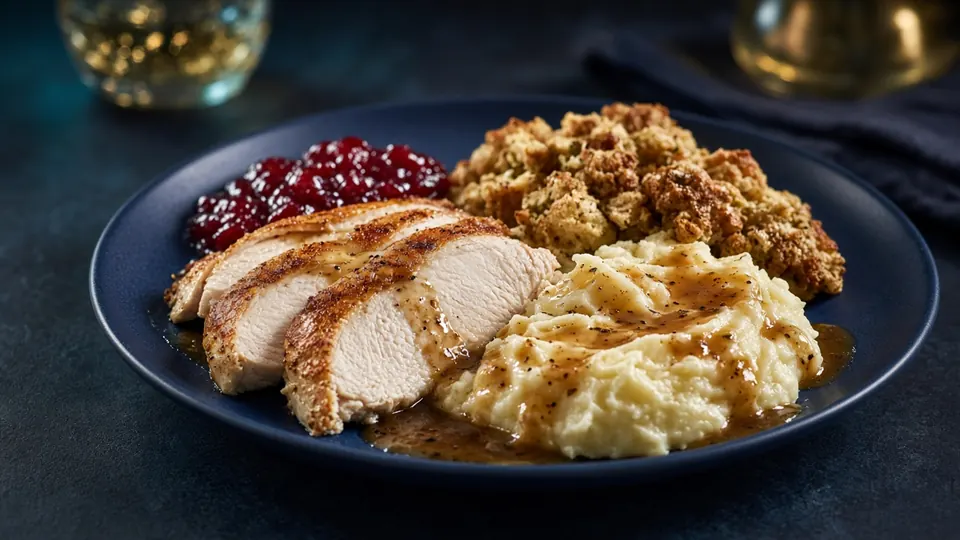
The centrepiece of Thanksgiving: a whole turkey roasted and served with gravy and vegetables.
Well-cooked hot dish
Ingredients
- turkey
- butter
- onion
- herbs
- salt
- pepper
- gravy
How it is prepared
The turkey is roasted until the thickest part reaches 74 °C (165 °F).
Food safety with low immunity
- Chicken and turkey must be fully cooked; keep raw poultry away from other foods and wash hands and boards after handling it.
How to prepare it during treatment
Stuffing is safer cooked separately rather than inside the bird.
Your diet during treatment is agreed with your doctor. Sample 7-day menu for the treatment period →
Storage
Once cooled, refrigerate (within 2 hours) and eat within 1–2 days.
Reheating
In the oven until hot in the centre; in a microwave, turn halfway.
Symptoms it may suit
- Low appetite. Gives a lot of energy and protein in a small portion — can help when appetite is low.
- Weight loss. Energy-dense and easy to enrich (oil, cheese, yoghurt) — can help with weight loss.
These are general observations: what suits you can change from day to day.
Treatment phases
- Before treatmentmay suit
- During a coursemay suit
- Low counts (neutropenia)Freshly cooked and hotmay suit
- Between coursesmay suit
- After treatmentmay suit
Phase notes are general. During low counts, follow only your care team’s food rules.
If you have other conditions
- Kidney disease, Liver disease. Rich in protein. With kidney or liver disease, protein amounts are set individually — discuss with your team.
- High blood pressure, Heart disease, Kidney disease. Often salty (stock, salty cheese, sausage, pickles). With high blood pressure, heart or kidney disease, discuss salt limits with your team.
Nutrition (per 100 g)
| Energy | 151 kcal |
|---|---|
| Protein | 28 g |
| Fat | 3.8 g |
| Carbohydrate | 0 g |
| Fibre | 0 g |
| Sodium | 464 mg |
Figures are for a comparable item in the USDA FoodData Central database: “Turkey, light and dark meat, roasted, skin not eaten”. Home recipes vary — treat this as a rough guide, not an exact calculation. USDA FoodData Central, FDC ID 2706113
More from this cuisine
Related topics
Food safetyNeutropenic diet (low-microbial diet)PasteurisedCore cooking temperatureLeftoversCross-contamination
Sources
- Centers for Disease Control and Prevention (CDC). Safer Food Choices for People With Weakened Immune Systems
- FoodSafety.gov (U.S. HHS). Cook to a Safe Minimum Internal Temperature
- USDA Food Safety and Inspection Service. Leftovers and Food Safety
- U.S. Food and Drug Administration (FDA). Food Safety for Older Adults and People with Cancer, Diabetes, HIV/AIDS, Organ Transplants, and Autoimmune Diseases
- Food Standards Agency (UK). Chilling
- World Health Organization (WHO). Five keys to safer food manual
- Memorial Sloan Kettering Cancer Center. Food Safety During Cancer Treatment
- National Cancer Institute (NCI). Eating Hints: Before, during, and after Cancer Treatment
- BMJ Supportive & Palliative Care, 2019. Neutropenic diets to prevent cancer infections: updated systematic review and meta-analysis
- U.S. Department of Agriculture (USDA). FoodData Central — Food and Nutrient Database for Dietary Studies (FNDDS)